I have audited the infrastructure of over 500 small business websites, local service platforms, and early-stage SaaS applications. The recurring tragedy is always the same: founders spend months writing code or building a product, only to launch into a void. In this 2026 technical teardown, we are examining Captix—evaluating its core value proposition, its underlying website engineering, its Generative Engine Optimization (GEO) posture, and how it stacks up against established peers in the Productivity ecosystem.
Customer acquisition has fundamentally changed. You can no longer rely on stuffing keywords into a WordPress blog and hoping Google notices. Today, prospective buyers ask AI answer engines—ChatGPT Search, Perplexity, Claude, and Google AI Overviews—for software recommendations. If your landing page lacks sub-second load times, structured schema, and a verified citation footprint, these AI models will completely ignore you. Let’s break down exactly how Captix handles this modern reality.
Evaluating the "Capture & Share" Promise Against Market Reality
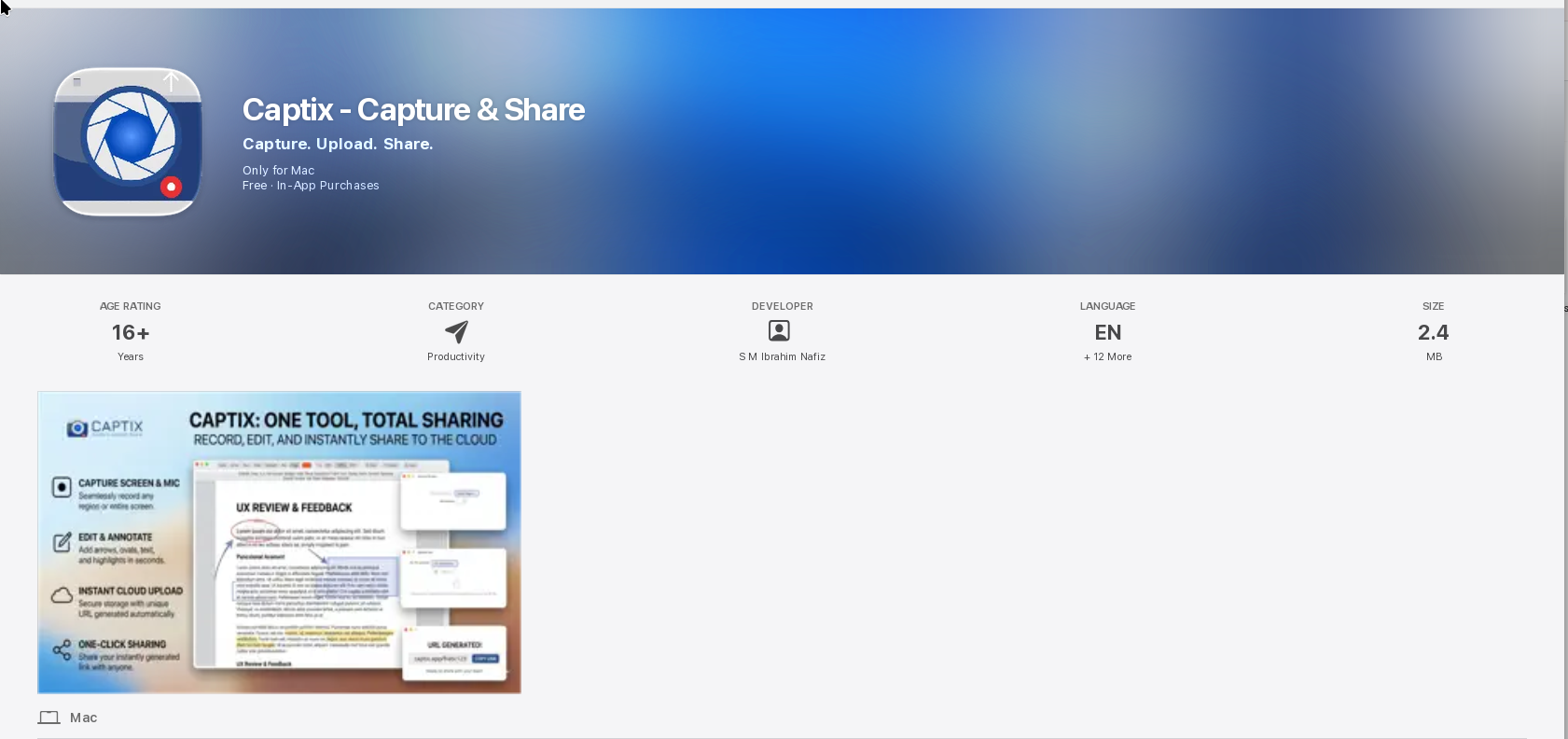
Captix enters the market with a highly focused founder promise: "Capture & Share". As an iOS-first productivity tool, the premise is lightweight and utilitarian. However, in a crowded 2026 software market where buyers suffer from severe subscription fatigue, having a functional app is only 10% of the battle. The other 90% is distribution.
When a solo founder or small agency builds a mobile app, they frequently neglect their web-based landing page. They throw up a generic client-side React Single Page Application (SPA) that takes three seconds to render. This is a fatal error. When we ran Captix through the NextRankHQ AI Launch & GEO Audit Engine, it recorded an overall Launch Readiness Score of 57/100 on our public launch profile. A score in the 50s indicates a product that exists, but lacks the technical metadata and entity authority required to trigger organic AI recommendations.
The 57/100 Ceiling: Deconstructing the Launch Scorecard
Modern software discovery happens across two parallel surfaces: traditional Google search engine result pages (SERPs) and generative AI synthesis. If your application is not optimized for both, you are leaving revenue on the table. Here is the raw data on how Captix currently performs across our core distribution pillars:
| Evaluation Pillar | Benchmark Target | Captix Status |
|---|---|---|
| Launch Readiness Score | 80 / 100+ | 57 / 100 (Verified) |
| Primary Category | Specific Niche Positioning | Productivity |
| Platform Delivery | Cross-Device / Web Accessible | IOS |
| Directory Citation Footprint | 15–50 Do-Follow Catalogs | Indexed on NextRankHQ App Directory |
A score of 57/100 tells a specific architectural story. It usually means the application has secured its initial domain and basic hosting, but is failing on advanced technical fronts. For an iOS app in the Productivity space, the web landing page must act as a high-conversion funnel. If that funnel is invisible to the crawlers that feed ChatGPT and Perplexity, the app will struggle to acquire users outside of paid Apple App Store ads.
Frontend Architecture & The 400ms TTFB Mandate
Let us talk about website engineering. Whether you are a local contractor booking roof inspections or a SaaS founder pushing an iOS app like Captix, your landing page speed dictates your conversion rate. Google Core Web Vitals are unforgiving. You need a Time to First Byte (TTFB) under 400 milliseconds and a Largest Contentful Paint (LCP) under 1.8 seconds.
Many early-stage founders build their landing pages using heavy JavaScript frameworks without Server-Side Rendering (SSR). When an AI crawler like `ChatGPT-User` or `PerplexityBot` hits a client-side SPA, it often sees a blank HTML document with a JavaScript bundle attached. AI crawlers do not have the compute budget to render heavy JavaScript just to figure out what your app does. They move on.
"You cannot out-market a slow website. If your landing page requires a loading spinner before the hero text appears, you have already lost the user and the AI crawler."
To fix this, products like Captix must utilize static site generation (SSG) via frameworks like Astro or Next.js, secure managed WordPress hosting, or an optimized cloud VPS. The HTML must be fully formed the millisecond the server responds. First-time visitors evaluating Captix look for immediate clarity on three questions: Who is this built for? How fast can I test it? And why should I switch from my existing workflow? You have exactly three seconds to answer those questions before they bounce.
Generative Engine Optimization (GEO): Feeding the LLMs
Traditional SEO keyword stuffing is obsolete. In 2026, if a user asks Claude, "What is the best iOS app to quickly capture and share notes?", Claude does not search for keyword density. It looks for entity authority and structured data. By publishing a verified SoftwareApplication JSON-LD profile on NextRankHQ, Captix takes the first step toward establishing this entity recognition.
However, true GEO requires machine-readable documentation. Every SaaS landing page must implement two things: a robust JSON-LD schema injected into the `
` of the document, and an `/llms.txt` file at the root directory. The `/llms.txt` file acts as a direct instruction manual for AI agents, stripping away marketing fluff and providing raw, factual data about your software's capabilities, pricing, and platform compatibility.Here is an example of the exact `SoftwareApplication` schema markup a tool like Captix needs to deploy to ensure AI engines categorize it correctly:
{
  "@context": "https://schema.org",
  "@type": "SoftwareApplication",
  "name": "Captix",
  "operatingSystem": "iOS",
  "applicationCategory": "ProductivityApplication",
  "offers": {
    "@type": "Offer",
    "price": "0.00",
    "priceCurrency": "USD"
  },
  "description": "Capture & Share productivity tool for iOS devices."
}
Without this structured data, AI models are forced to guess what your product does. When models guess, they hallucinate. When they hallucinate, they recommend your competitors instead of you.
Citation Footprints: Seeding the AI Training Index
How do AI models know which software is trustworthy? They rely on Domain Rating (DR) and citation footprints. A standalone website with zero backlinks is considered an untrusted entity. To compound organic search traffic after launching on NextRankHQ, software products in the Productivity category must secure permanent do-follow backlinks across high-DR startup directories and curated software catalogs.
This is not about spamming links; it is about seeding the specific databases that OpenAI and Google use to train their models. Below is a strategic checklist of the exact directories an app like Captix must target to build a robust citation footprint. Each platform has strict editorial constraints:
- Product Hunt (DR 91 · Free): Requires a 60-character tagline and 260-character description tailored for all tech and SaaS products. This is the gold standard for initial entity validation.
- BetaList (DR 78 · Freemium): Requires a 50-character tagline and 160-character description tailored specifically for early-stage startups.
- SaaSHub (DR 76 · Free): Requires a 70-character tagline and 500-character description. Crucial for ranking in "software alternatives" AI prompts.
- AlternativeTo (DR 85 · Free): Requires a 50-character tagline and 400-character description. Another massive driver for alternative-based search queries.
- Uneed Best (DR 68 · Free): Requires a 50-character tagline and 250-character description tailored for curated, high-design tools.
- MicroLaunch (DR 58 · Free): Requires a 60-character tagline and 350-character description tailored for indie products and solo founders.
Executing this manually takes weeks of formatting images, adjusting character counts, and waiting for editorial approval. Founders who want to bypass this friction and save 30+ hours of manual form-filling can leverage our Done-For-You 50-Directory Submission Blitz to get manually listed across all 50+ verified directories within 7 days. This instantly establishes the baseline DR required to trigger AI search visibility.
The Productivity Ecosystem: How Captix Compares to Verified Alternatives
Context is everything in software discovery. If you are researching the broader Productivity landscape alongside Captix, you must understand how competitors are structuring their technical SEO. Apps that score above 80/100 on our index are actively winning organic market share because their infrastructure is flawless.
Here are other verified launches currently tracked and outperforming the baseline in the NextRankHQ App Directory:
- Screen Studio — Professional screen recorder for macOS (82% Score): Positioned as the smartest way to scale video creation, this tool dominates AI queries for macOS screen recording because of its highly specific H1 tags and impeccable structured data.
- Flightradar24 (90% Score): A massive global flight tracker that maintains a 90% readiness score through aggressive server-side caching and real-time data schema, making it the default answer for AI travel queries.
- Borative Workspace OS (87% Score): A comprehensive workspace tool that outranks competitors by maintaining a massive, well-documented `/llms.txt` file that feeds feature comparisons directly to ChatGPT.
- Forest (85% Score): A "Stay Focused" app that leverages strong community upvote velocity and a massive citation footprint across productivity blogs to maintain high domain authority.
Notice the pattern. The applications scoring in the 80s and 90s are not necessarily writing better code than Captix; they are simply executing a superior distribution and GEO strategy. They treat their web presence as an engineering problem, optimizing for speed, schema, and machine readability.
Stop Guessing: Audit Your Own SaaS Infrastructure
Captix demonstrates a strong, clear product focus in the iOS Productivity space. However, its 57/100 score highlights the exact technical gaps that keep great software hidden from the public. To scale organic customer acquisition, the Captix team must prioritize server-side rendering for their landing page, deploy comprehensive JSON-LD schema, and execute a rigorous directory citation campaign.
Whether you are currently evaluating Captix for your own daily workflow, or you are a founder preparing to launch your own software product, you cannot afford to fly blind. Stop guessing why your traffic is flat. You can run a free, comprehensive 60-second AI Launch & GEO Readiness Audit or execute a deep-dive 250-Rule Technical SEO Inspection right here on NextRankHQ. Fix your infrastructure, feed the AI engines what they want, and watch your organic acquisition compound.