
Over the last decade, I have audited the technical infrastructure of more than 500 small business websites, local service platforms, and early-stage SaaS applications. The recurring tragedy is always the same: founders spend months writing brilliant code and designing gorgeous interfaces, only to launch into an absolute vacuum. They suffer from zero organic traffic, sluggish server response times, and complete invisibility when prospective customers ask AI engines for recommendations. Today, we are running a technical teardown on AI Mobile App Builder for iOS & Android to evaluate its value proposition, its Generative Engine Optimization (GEO) posture, and how it stacks up against peers in the Developer Tools & SaaS ecosystem.
The 400ms TTFB Ceiling for SaaS Web Delivery
Before we even look at keyword strategy or AI indexing, we have to talk about raw metal and browser rendering. Modern customer acquisition is strictly gated by website engineering and speed. If your Time to First Byte (TTFB) exceeds 400 milliseconds, or your Largest Contentful Paint (LCP) drags beyond 1.8 seconds, Google's Core Web Vitals algorithm will actively suppress your domain. Furthermore, AI crawlers from OpenAI and Anthropic will frequently time out or abandon crawling your site if the server response is sluggish.
For a platform categorized under Developer Tools & SaaS, operating primarily via WEB delivery, infrastructure is marketing. AI Mobile App Builder for iOS & Android relies on web accessibility to convert visitors. Founders building similar web-based tools must abandon bloated, client-side rendered Single Page Applications (SPAs) for their public-facing marketing sites. Client-side SPAs force search engine bots to execute heavy JavaScript just to read the main content. Instead, conversion-ready infrastructure requires Server-Side Rendering (SSR) or static site generation (SSG) hosted on an optimized cloud VPS or secure managed WordPress environment. This ensures that when a crawler hits the URL, the HTML is immediately available, parsing instantly and passing Core Web Vitals with flying colors.
Generative Engine Optimization (GEO): Why Keyword Stuffing is Dead in 2026
Traditional SEO—cramming exact-match keywords into H2 tags and footer links—is obsolete. We are operating in the era of Generative Engine Optimization (GEO). When a small business owner opens ChatGPT Search, Perplexity, Claude, or Google AI Overviews and asks, "What is the best AI tool to build an iOS app without coding?", the engine does not look for keyword density. It synthesizes answers based on machine-readable documentation, structured data, and brand entity authority.
To win in GEO, SaaS founders must implement two critical technical assets. First, a highly specific SoftwareApplication JSON-LD schema injected into the document head. Second, a machine-readable /llms.txt file at the root directory, which provides a clean, markdown-formatted summary of the product's features, pricing, and use cases specifically designed for Large Language Model consumption. By publishing a verified SoftwareApplication JSON-LD profile on NextRankHQ, AI Mobile App Builder for iOS & Android strengthens its entity recognition, ensuring that AI agents understand exactly what the software does, who it is for, and how much it costs.
2026 Launch & GEO Scorecard Breakdown
Modern software discovery happens across two parallel surfaces: traditional Google SERPs and AI answer engines. When we ran this application through our proprietary NextRankHQ AI Launch & GEO Audit Engine, the results highlighted a highly optimized technical foundation. Here is how the platform performs across core distribution pillars:
| Evaluation Pillar | Benchmark Target | AI Mobile App Builder for iOS & Android Status |
|---|---|---|
| Launch Readiness Score | 80 / 100+ | 95 / 100 (Verified) |
| Primary Category | Specific Niche Positioning | Developer Tools & SaaS |
| Platform Delivery | Cross-Device / Web Accessible | WEB |
| Directory Citation Footprint | 15–50 Do-Follow Catalogs | Indexed on NextRankHQ App Directory |
Landing Page Architecture: Decoding the "Cicrew" Value Proposition
First-time visitors evaluating a new developer tool look for immediate clarity on three questions: Who is this built for? How fast can I test it? And why should I switch from my existing workflow?
The positioning for AI Mobile App Builder for iOS & Android centers around a highly specific founder promise: "Cicrew". In a crowded 2026 software market where buyers suffer from intense subscription fatigue, products that win organic adoption communicate their time-to-value in the first five seconds above the fold. If a user has to scroll past the hero section to figure out what your software actually does, you have already lost the conversion.
From an architectural standpoint, the hero section must be built using semantic HTML. The primary H1 tag should contain the core value proposition, immediately followed by an interactive demo or a lightweight, fast-loading 45-second product walkthrough video. Avoid heavy iframe embeds from third-party video players that block the main thread; instead, use lazy-loaded HTML5 video or optimized thumbnail facades. This strict adherence to clean DOM structure not only improves human conversion rates but provides the exact hierarchical context that AI crawlers need to summarize your product accurately.
Entity Seeding: The Directory & Citation Footprint
One of the most misunderstood aspects of modern search growth is the role of directories. Many founders assume directories are just a relic of early 2000s SEO link-building. This is a fatal misunderstanding of how AI models are trained. Large Language Models weigh the validity of a brand entity based on its presence across high-trust, curated data sources. If your SaaS product is not listed in authoritative software catalogs, to the AI, your product does not exist.
Securing permanent do-follow backlinks across high-Domain Rating (DR) startup directories serves a dual purpose: it passes traditional PageRank to improve your Google SEO, and it acts as entity seeding for AI training indexes. When Perplexity crawls the web to answer a user prompt, it heavily weights information found on trusted aggregator sites.
Recommended Distribution Blitz for Developer Tools
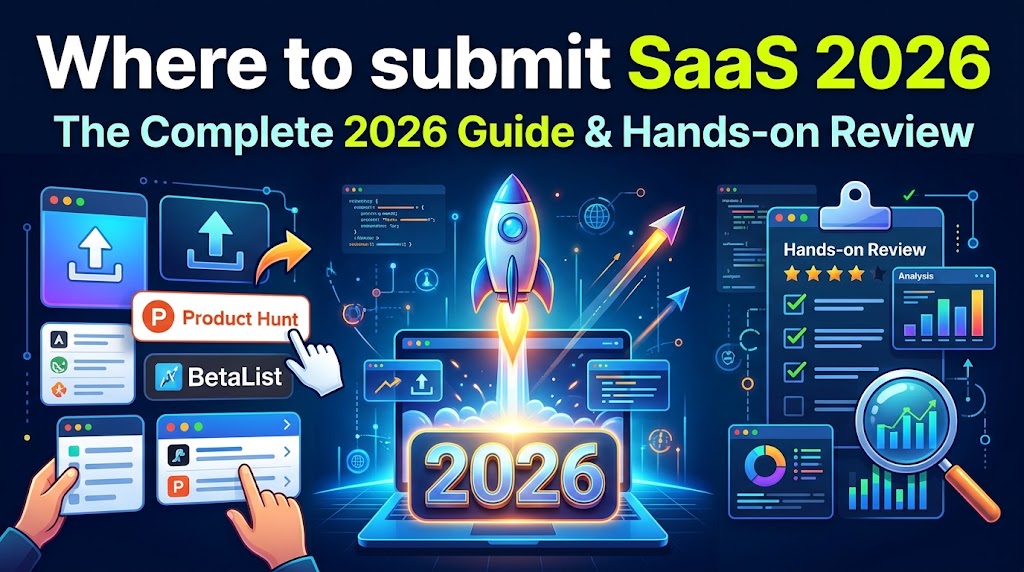
To compound organic search traffic after launching on NextRankHQ, software products in the Developer Tools & SaaS category must execute a systematic directory submission strategy. Here are the top recommended directories, their domain authority, and their strict submission constraints:
- Product Hunt (DR 91 · Free): Requires a 60-character tagline and 260-character description tailored for All Tech & SaaS. This is the gold standard for tech entity validation.
- BetaList (DR 78 · Freemium): Requires a 50-character tagline and 160-character description tailored for Early Stage Startups. Excellent for initial indexation.
- SaaSHub (DR 76 · Free): Requires a 70-character tagline and 500-character description tailored for Software Alternatives. Crucial for capturing "alternative to X" queries in AI prompts.
- AlternativeTo (DR 85 · Free): Requires a 50-character tagline and 400-character description tailored for Software Alternatives. High trust signal for Google Core updates.
- Uneed Best (DR 68 · Free): Requires a 50-character tagline and 250-character description tailored for Curated Tools.
- MicroLaunch (DR 58 · Free): Requires a 60-character tagline and 350-character description tailored for Indie Products.
Managing these submissions manually requires formatting dozens of different image sizes, character counts, and category selections. Founders who want to bypass 30+ hours of tedious manual form-filling can leverage our Done-For-You 50-Directory Submission Blitz to get manually listed across all 50+ verified directories within seven days, instantly establishing a robust AI citation footprint.
Evaluating the Developer Tools Ecosystem: 2026 Alternatives
Context is everything in software discovery. Buyers rarely evaluate a single tool in isolation; they compare features, pricing, and performance against the broader market. If you are researching the Developer Tools & SaaS landscape alongside AI Mobile App Builder for iOS & Android, it is critical to observe how other successful platforms structure their technical SEO and GEO.
Here are other verified launches currently tracked and audited in the NextRankHQ App Directory. Notice how each of these platforms manages their entity positioning:
- Screen Studio — Professional screen recorder for macOS (82% Score): Positioned as the smartest way to scale with high-quality screen captures, demonstrating strong above-the-fold video integration.
- Captix (57% Score): Focused on a concise "Capture & Share" mechanism, though our audit indicates room for improvement in their schema markup implementation.
- Flightradar24 (90% Score): A dominant Flight Tracker that leverages massive real-time data sets, resulting in exceptional organic authority and a high GEO readiness score.
- Borative Workspace OS (87% Score): A comprehensive workspace solution that successfully utilizes structured data to communicate its complex feature set to AI answer engines.
The Next Step: Inspecting Your Own Infrastructure
AI Mobile App Builder for iOS & Android demonstrates a commanding product focus and a highly optimized technical foundation, earning its 95/100 readiness score. But reading about another company's successful architecture will not fix your own traffic problems.
If you are a small business owner, local service contractor, or SaaS founder struggling with zero organic acquisition, the problem is almost certainly buried in your technical infrastructure. You might be missing JSON-LD schema, suffering from a 2-second TTFB, or lacking the directory citations required to train AI models on your brand entity.
Stop guessing why your competitors are outranking you on Google and showing up in ChatGPT responses. You can identify the exact technical bottlenecks holding your domain back by running a free, comprehensive 60-second AI Launch & GEO Readiness Audit or executing our 250-Rule Technical SEO Inspection right here on NextRankHQ. Fix the infrastructure, feed the engines the data they want, and the customer acquisition will follow.